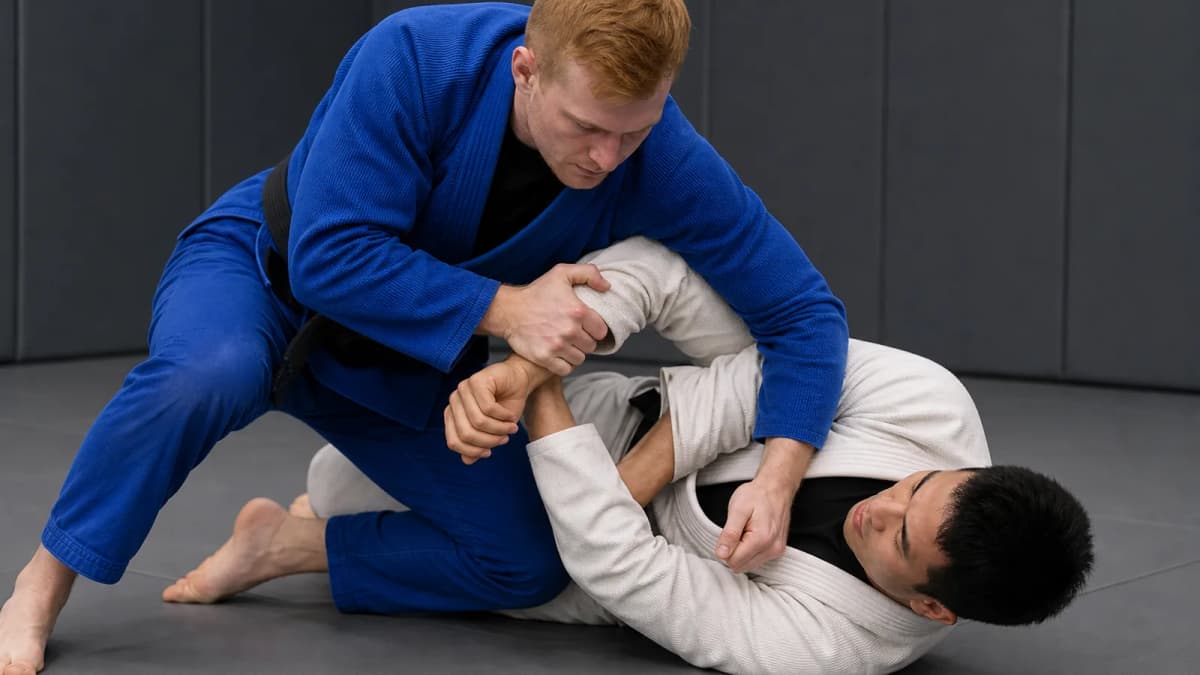
Leverage: The Power Multiplier
Make every grip count: harness mechanical advantage so technique beats strength in every position.
Leverage is the mechanical advantage that lets smaller practitioners dominate bigger opponents. By creating fulcrums, wedges, and angles, you multiply force with minimal effort.
Two Limbs vs. One
Whenever possible, use both your legs or both arms against a single limb for instant leverage advantage.
Win the Fulcrum
Position hips, knees, or elbows as fulcrums near the target joint—small shifts create massive leverage changes.
Angle Before Force
Rotate or reposition before squeezing. Proper angle makes submissions and sweeps effortless.
Fulcrum + Force = Result
Use a fixed point (your hip, knee, or grip) to pivot their limb or posture where they are weakest.
Leverage Stacks
Combine wedges, frames, and rotation to multiply force. The more pieces you layer, the less effort required.
Length Over Strength
Extend your lever (hips, legs, arms) farther than theirs. Longer levers produce more torque with less energy.
Move Around, Not Through
Instead of fighting resistance head-on, change the angle or move around the obstacle. Proper leverage makes stubborn frames vanish.
Sensitivity Beats Muscle
Feel where their structure is weak. Leverage takes advantage of slack and alignment errors; strength ignores them.
Armbar Mechanics
Finishing armbars when opponent resists with grip strength.
- Pinch knees and control thumb orientation so elbow aligns with your fulcrum (hips).
- Lift hips while pulling wrist to extend lever and break grip tension.
- Need less power? Scoop their near-side leg with your arm to add rotational leverage.
Triangle Choke Efficiency
Opponent postures up or stacks to escape triangle.
- Create an angle by pulling their head down and cutting your hips.
- Use hamstring squeeze as the lever while your calf wedges their neck.
- Grab shin, not foot, to close the loop—short lever equals more bite.
Hip Bump Sweep Leverage
Attacking from closed guard against a strong base.
- Post hand behind you and hook their arm to create a fulcrum.
- Explode hips diagonally, using your torso as the lever across their trapped arm.
- Finish by rotating your chest over them before landing mount.
Train multiple leverage points in sequence.
- From closed guard, flow armbar → triangle → omoplata without using hand grips.
- Focus on hip angle changes and leg positioning—leverage, not strength, drives the transitions.
- Repeat on both sides, aiming for smooth, low-effort movement.
Feel leverage instead of forcing it.
- Partner offers 20%, 40%, then 60% resistance to your submission attempts.
- Each time resistance increases, adjust angle or lever length instead of pulling harder.
- Discuss afterwards where leverage succeeded versus where strength crept in.
- Hips lead the motion—arms direct, body delivers.
- If you feel strain, change the angle before applying more force.
- Your levers should be long and aligned; theirs should be short and twisted.
- Technique is leverage applied intelligently.
- Small adjustments unlock big results.
- Power is generated from structure, not strain.
- Pulling with arms, forgetting to engage hips or legs.
- Trying to muscle submissions after losing the angle.
- Locking yourself into one lever instead of flowing to a stronger setup.
Learning Benchmarks
- You can identify fulcrums in three core submissions (armbar, triangle, kimura).
- You can finish an armbar using less than 50% of your perceived strength.
- You explain how lever length affects torque in at least two sweeps.
Rolling Objectives
- Track submissions finished via angle changes versus raw strength.
- Log sweeps that worked because you moved their base instead of pushing it.
- Note how often you transition leverage when initial attempts stall.
Reflection Prompts
- Did you rely on muscle when leverage slipped?
- Which adjustments immediately made techniques easier?
- How can you add an extra lever or wedge next session?
- Combine leverage with base lessons to stay stable while applying mechanical advantage.
- Revisit leverage concepts during positional sparring—ask “Where is my fulcrum?” every round.
- Watch high-level matches focusing solely on how athletes create angles before finishing.
- Partners comment that you feel “tight” without squeezing hard.
- Your submissions succeed faster with less energy.
- You instinctively change angles rather than tugging harder when resistance appears.