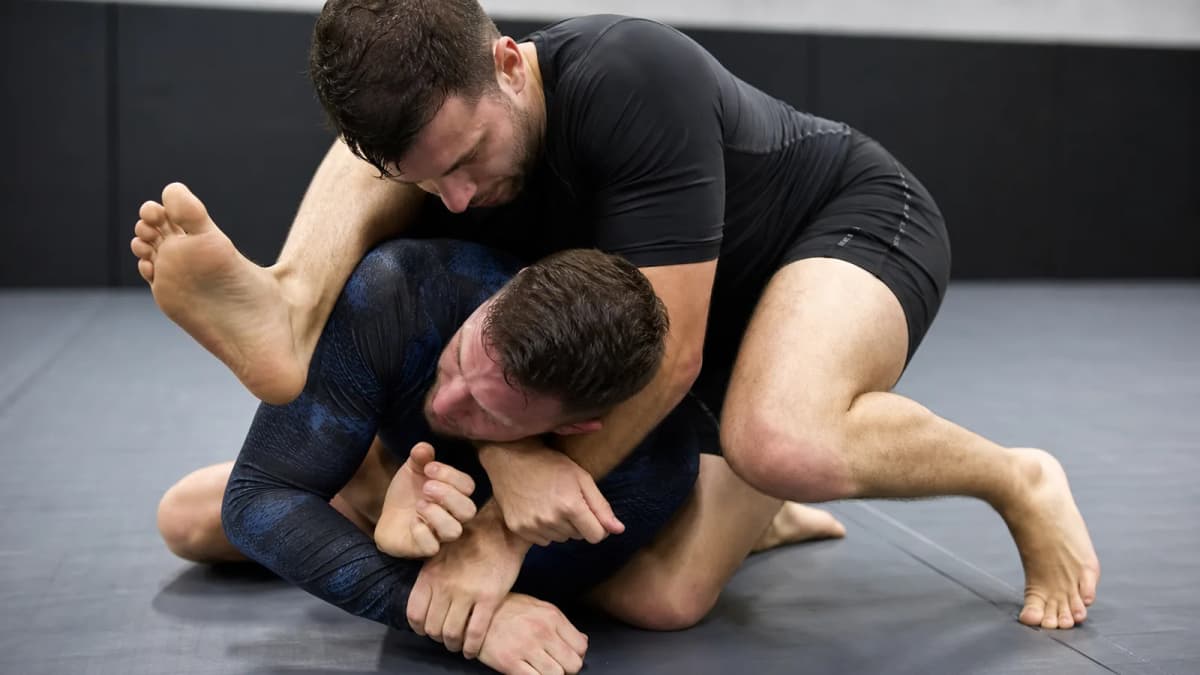
What is the Peruvian Necktie?
The Peruvian necktie clamps the head and near arm from front headlock, then steps a leg over their shoulder/back and tips or rolls to finish the strangle. It appears when opponents defend a standard guillotine by posting and staying heavy, giving you the angle to throw a leg over and tip.
Setup
- Secure a front-headlock grip with the head and near shoulder trapped.
- Keep their posture broken so they cannot circle out early.
- Create space to step a leg over the near shoulder/back line.
Execution
- Throw the near leg over their back/shoulder while maintaining the headlock.
- Clamp the choke tighter as the leg lands and their posture collapses.
- Tip or roll toward the trapped side to close the carotid line.
Finishing
- Keep the grip locked through the tip — do not open hands mid-roll.
- If the finish stalls, return to guillotine, Japanese necktie, or darce paths.
- Release on tap; neckties escalate quickly when aligned.
⚠️
Safety Note
Peruvian necktie loads the neck during a tip/roll. Apply pressure gradually in training and avoid explosive snaps when the head is trapped.
Primary Targets
- Neck
- Carotid arteries
Key Concepts
- It is a front-headlock finish that uses a leg over the shoulder to tip.
- Posture break before the step-over.
- Have a return path to guillotine or Japanese necktie when they sprawl free.
Primary Entries
- Failed guillotine when they post and stall in front headlock.
- Snap-down or sprawl scrambles that gift a deep head-and-arm clamp.
- Turtle front-headlock battles where a high elbow invites the step-over.
Defenses & Counters
- Expect them to circle the free hip and peel the leg — follow or abandon early.
- Watch for hand fighting that loosens the headlock before you tip.
- If they square and elevate, reset to a clearer front-headlock finish.
Follow-Ups
- Japanese necktie when the clamp is high on the shoulder.
- Guillotine if the arm slides out and the neck remains trapped.
- Anaconda or darce when the arm-in geometry appears instead.
Training Drills
- Front-headlock to Peruvian step-over on cooperative partners
- Tip finishes without hard neck snaps
- Guillotine to necktie recognition rounds
Related Techniques
Deepen your study with complementary positions and attacks.
Summary
Peruvian necktie clamps front headlock, steps a leg over the shoulder, and tips to finish. Break posture first, keep the grip through the roll, and return to guillotine or Japanese necktie when the geometry breaks.