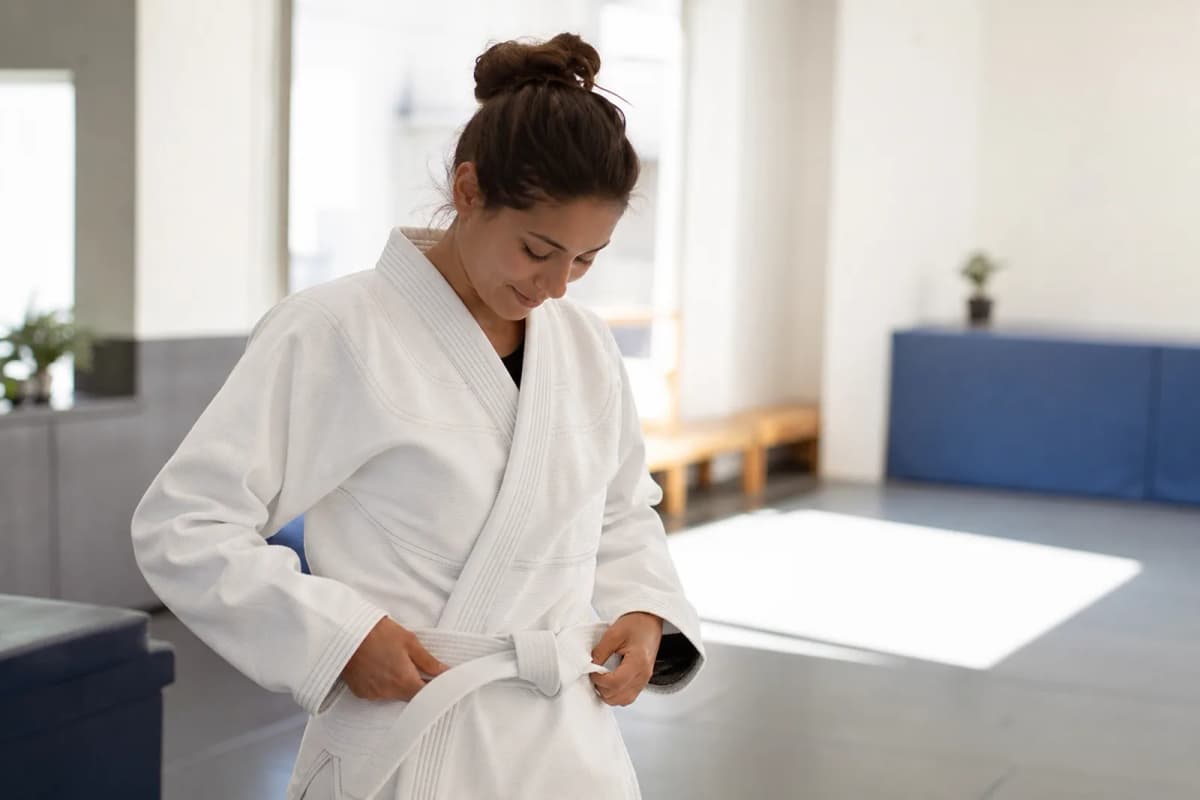
The adult BJJ belt order is white, blue, purple, brown and black. After black come six degrees, then the coral belts and the red belt. Kids under 16 have a separate ladder of 13 belts. The minimums below come from the IBJJF graduation system; your own academy decides when you are ready.
Adult BJJ belt order with IBJJF minimums
The IBJJF sets a minimum age for each belt and a minimum time you must hold it before the next one.
| Belt | Minimum age | Minimum time before the next belt | What it usually means |
|---|---|---|---|
| White | Any | No minimum | Learning to survive, escape and hold basic positions |
| Blue | 16 | 2 years | Solid defense and a few attacks that work on resisting partners |
| Purple | 16 | 18 months | A personal game: guards, passes and submissions that link together |
| Brown | 18 | 1 year | Refining the game and closing holes before black belt |
| Black | 19 | 3 years to 1st degree | Expert level; many black belts teach |
Black belt degrees, coral and red belts
Black belts do not get stripes. They earn degrees, and the most senior ranks change belt color. Full timeline and earliest ages: coral, red and kids belts.
| Rank | Belt | Minimum wait to reach it |
|---|---|---|
| 1st to 3rd degree | Black | 3 years each |
| 4th to 6th degree | Black | 5 years each |
| 7th degree | Red and black (coral) | 7 years |
| 8th degree | Red and white (coral) | 7 years |
| 9th degree | Red | 10 years; highest rank on the 2026 IBJJF chart |
Kids BJJ belt order (under 16)
Kids belts follow age as well as skill. Each color has a white-striped, plain and black-striped version.
| Color group | Belts in order | Earliest age |
|---|---|---|
| White | White | 4 |
| Grey | Grey-white, grey, grey-black | 4 |
| Yellow | Yellow-white, yellow, yellow-black | 7 |
| Orange | Orange-white, orange, orange-black | 10 |
| Green | Green-white, green, green-black | 13 |
From kids belts to adult belts at 16
At 16 every kids belt converts to an adult belt.
- White belts stay white.
- Grey, yellow and orange belts become white or blue, at the instructor's discretion.
- Green belts become white, blue or purple, at the instructor's discretion.
- For competition, 16- and 17-year-olds compete as juveniles, at white, blue or purple, and use the adult white belt column of illegal moves. The IBJJF rules checker shows what that column allows.
Stripes and how long each belt really takes
The IBJJF minimums are floors. Real timelines depend on how often you train and on your academy.
- Most academies give up to four stripes on each belt below black. Stripes are progress markers, not a countdown.
- Adults who train two to four times a week commonly reach blue in 1.5 to 3 years. Most coaches first want to see a white belt escape bad positions and finish a few basics, such as the triangle choke and the rear naked choke.
- A common estimate for black belt is around a decade. Very few people reach it in the minimum time. The brown belt roadmap and black belt roadmap show what that last stretch usually covers.
- Promotions are decided by your instructor, not by a test the IBJJF runs. The IBJJF registers members’ belts and certifies black belts. Our BJJ belt roadmaps break each rank into a 12 to 16 week study plan.
Key Takeaways
- Adult belt order: white, blue, purple, brown, black.
- IBJJF minimum ages: 16 for blue and purple, 18 for brown, 19 for black.
- Minimum time: 2 years at blue, 18 months at purple, 1 year at brown.
- After black: six degrees, then red-and-black, red-and-white and red belts.
- Kids under 16 move through grey, yellow, orange and green before adult belts.
Further Study
White belt roadmap
What to learn first, position by position.
Blue belt roadmap
The skills most coaches look for before blue.
Purple belt roadmap
Building a connected game.
Brown belt roadmap
Refining your game before black belt.
Black belt roadmap
What black belt level looks like.
Brazilian jiu-jitsu ranking system (Wikipedia)
Summary of the IBJJF graduation system with sources.