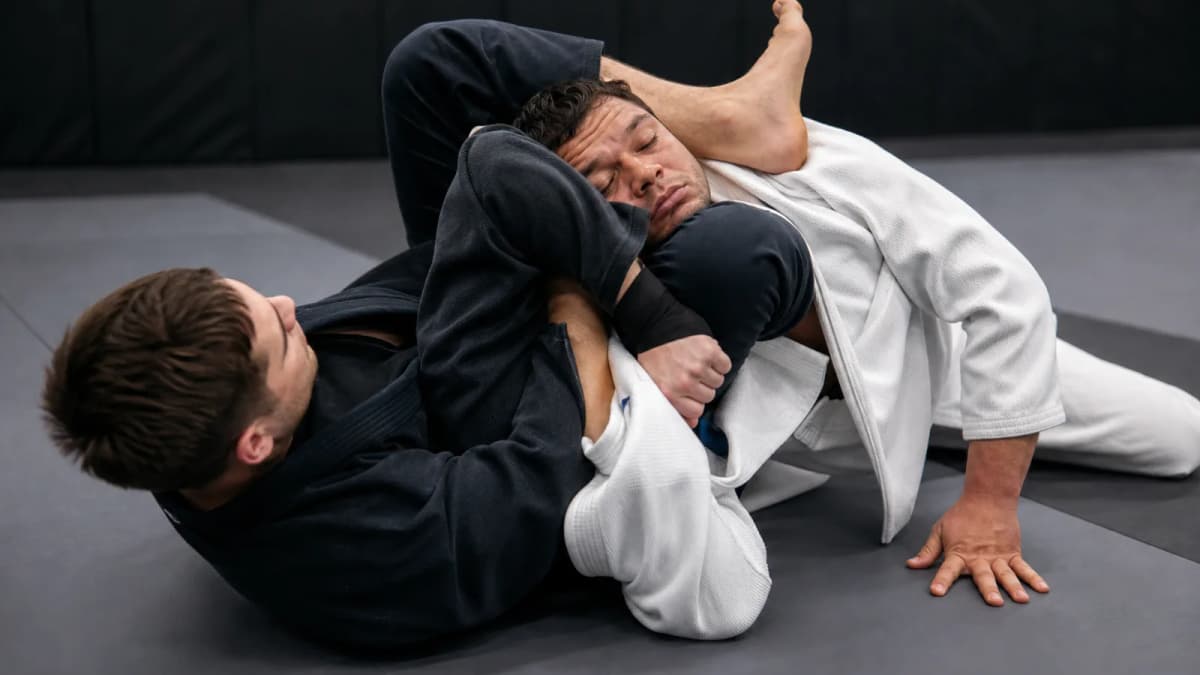
Triangle Choke
One of the most iconic guard submissions, trapping the opponent between your legs to constrict blood flow and shoulder mobility.
blood choke
Overview
The triangle choke uses the legs to create a powerful vice around the opponent’s neck and trapped arm. By breaking posture, capturing a single arm, and rotating to a finishing angle, practitioners can apply a tight strangulation without relying on upper-body strength. Mastering the triangle makes the guard a true offensive hub.
#Setup
#Execution
- Rotate to a perpendicular angle by posting on the mat or grabbing the shin.
- Clamp the head toward the locked knee, eliminating daylight near the neck.
- Hide your locking foot beneath the knee crease while squeezing the thighs inward.
#Finishing
⚠️
Safety Note
Avoid yanking on the head before the choke is locked—use hip positioning first to prevent neck strain for both partners.
Primary Targets
- Neck
- Carotid arteries
- Shoulder line
Key Concepts
- Create an angle off to the side rather than finishing square to the opponent.
- Control the wrist of the trapped arm to keep the shoulder line compressed.
- Clamp your knees and engage hamstrings before pulling on the head.
- Grab your own shin before locking to maintain height on the triangle frame.
- Use an underhook on the far leg to defend stack attempts and maintain angle.
- Pinch the knees to remove daylight around the opponent’s trapped shoulder.
- Fight for sleeve or wrist control to keep the arm across the centerline.
- Control the head to prevent posture and limit space for breathing.
- Switch between collar, shin, and frame grips as the opponent stacks or circles.
- Lock the triangle loosely first, then adjust the angle before final squeeze.
- Keep your hips elevated throughout to stop the opponent from creating posture.
- Finish patiently—incremental tightening outperforms explosive squeezing.
- Tuck the locking foot behind the knee rather than crossing ankles.
- Point the knee of the choking leg toward the ceiling to close space.
- Elevate the hips while pulling the head down for a blood choke instead of a crank.
- Watch classic instructionals from Rickson Gracie, Renzo Gracie, and modern breakdowns by Ryan Hall.
- Analyze slow-motion competition footage to see how quick angle changes secure the finish.
Primary Entries
- Closed guard posture breaks leading to arm isolation.
- Lasso or spider guard setups that force the opponent to post an arm.
- Transition from failed armbar when the opponent drives their arm across.
Defenses & Counters
- Opponents will drive knees under your tailbone—angle off and adjust hips immediately.
- Watch for shoulders slipping through; re-zip the knees to seal the space.
- Anticipate standing breaks—use your leg to hook behind their knee or ankle.
- Expect the opponent to stack—frame on the opponent’s hip and underhook the leg to relieve pressure.
- Track posture attempts by gripping the head and re-breaking the spine line.
- Switch to an armbar or omoplata if the trapped arm starts to slip free.
- Opponent threading their free arm through to create posture—reset grips quickly.
- Stacking pressure that forces your knees open—control the hip line to stay attached.
- Late escapes by slipping the trapped arm—clamp elbows to your ribs to hold it in place.
Follow-Ups
- Mounted triangle after sweeping to the top.
- Flower sweep or pendulum motion into mounted armbar sequences.
- Back take when the opponent turns away to relieve the choke pressure.
- Hip bump sweep when the opponent stands up hard to escape.
- Armbar finish if the opponent extends the trapped arm to create space.
- Omoplata when they roll their shoulder forward to lighten pressure.
Related Techniques
Deepen your study with complementary positions and attacks.
Summary
The triangle choke keeps guard players dangerous even against larger opponents. Stay disciplined with posture-breaking, angle management, and leg clamps, and the submission becomes a reliable fight-ending weapon at every level.