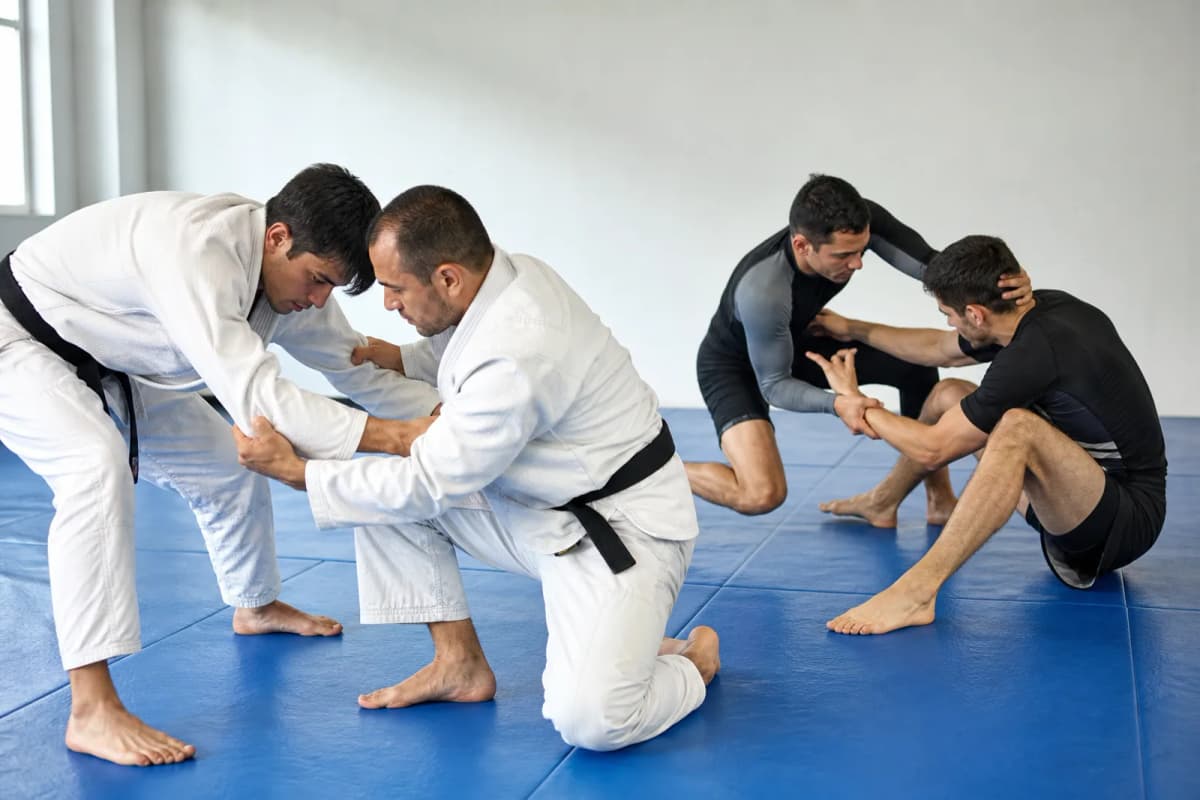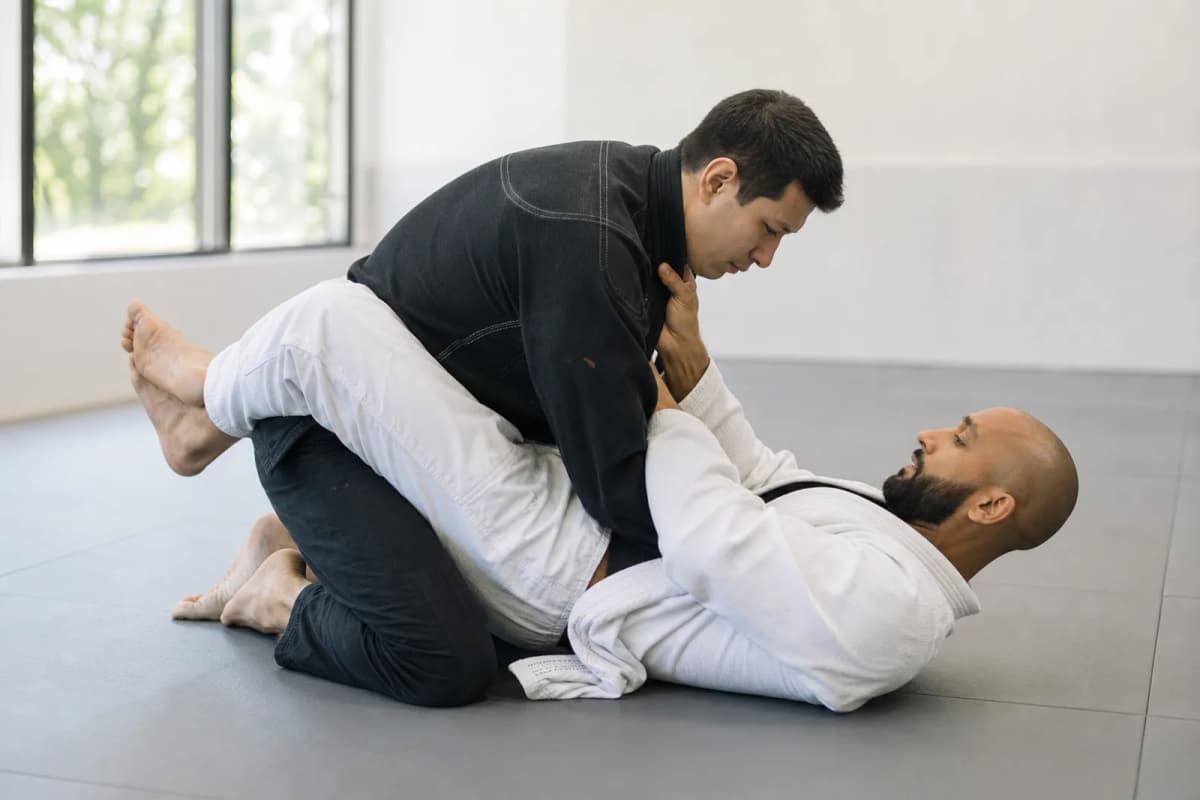
BJJ, judo and wrestling are all grappling sports, but their rules reward different things. Judo is won mostly by throws, wrestling by takedowns and pins, BJJ by submissions and dominant positions on the ground. Muay Thai is a striking sport, and MMA combines striking and grappling. Each rule comes from the sources listed at the end, mostly the official rule books.
The rules side by side
How each sport is won and what is allowed, under the rule set most people mean when they name the sport.
| Sport (rule body) | How you win | Submissions | Strikes | Pins |
|---|---|---|---|---|
| BJJ (IBJJF) | Submission, or points then advantages | Chokes and joint locks, restricted by belt and age | None | No pin win; mount and back control score 4 points |
| Judo (IJF) | Ippon: a clean throw, a 20-second hold, a submission or two waza-ari | Chokes and armlocks (elbow only) | None | 20 s ippon, 10–19 s waza-ari, 5–9 s yuko |
| Freestyle wrestling (UWW) | Fall, 10-point lead, or points after 2 × 3 minutes | None: chokes and arm twisting past 90° are illegal | None | A fall (both shoulders held on the mat) ends the bout |
| Greco-Roman wrestling (UWW) | Fall, 8-point lead, or points | None | None | Same fall rule; no grabbing below the belt |
| Muay Thai (IFMA) | Scoring strikes or knockout | None: joint locks are a foul | Punches, kicks, knees, elbows | No ground fighting |
| MMA (Unified Rules) | Submission, KO, TKO or decision | Yes; small-joint manipulation is a foul | Yes, with fouls such as strikes to the back of the head | No pin win |
Jiu jitsu vs judo
Both are gi grappling sports, but judo is decided mostly standing and BJJ mostly on the ground.
- Scores: judo has ippon, waza-ari and yuko. The IJF brought yuko back for the 2025 rules; it covers landings on the side and holds of 5 to 9 seconds. Two waza-ari make ippon.
- Pins: an osaekomi (hold-down) scores waza-ari at 10 seconds and ippon at 20. In BJJ, holding someone down scores nothing on its own; you score for reaching side control by passing the guard (3 points) or for mount and back control (4).
- Leg grabs: the IJF began restricting them in 2010 and banned any attack below the belt in 2013. Under the current rules every grab below the belt, trousers included, is a shido, and the third shido is hansoku-make. BJJ allows leg attacks, and single and double legs score as takedowns.
- Submissions: judo allows chokes and armlocks, but joint locks only on the elbow. BJJ adds wrist locks, shoulder locks and leg locks, with restrictions by belt.
- Match length: a senior judo contest is 4 minutes, then golden score if tied. Adult IBJJF matches run 5 minutes at white belt up to 10 at black belt.
- What carries over: a judo throw that lands you on top in control scores 2 points as a takedown in IBJJF. Guard play is usually the biggest new skill for judo players.
Jiu jitsu vs wrestling
Wrestling has no submissions, and being on your back loses. BJJ is built around fighting from your back.
- Olympic wrestling (freestyle and Greco-Roman) runs under UWW rules: two 3-minute periods with a 30-second break for seniors.
- A fall ends the bout: the defending wrestler held with both shoulders on the mat. A lead of 10 points in freestyle, or 8 in Greco-Roman, ends it by technical superiority.
- Greco-Roman forbids grabbing below the belt line and actively using the legs. Freestyle allows leg attacks.
- UWW rules ban every form of strangulation, arm twisting past 90 degrees and arm locks on the forearm, so there is no submission game at all.
- US high school and college wrestling use folkstyle, which rewards control on the mat. College matches have three periods (3, 2 and 2 minutes); a takedown is 3 points, an escape 1, and a wrestler with over a minute of net riding time gets an extra point.
- What carries over: takedowns, top pressure and scrambling transfer straight to BJJ, especially no-gi. What does not: wrestlers turn away from their back to avoid a fall, which in BJJ often gives up the back, worth 4 points. Our gi vs no-gi guide covers where wrestling fits best.
Jiu jitsu vs Muay Thai
Muay Thai is striking. Its grappling is limited to the clinch.
- Under IFMA rules a scoring technique is a punch, kick, knee or elbow landed with force on a scoring target.
- Fouls include hip throws, tackling the body or legs, locking or hyperextending any joint, and striking an opponent who is down. There is no ground fighting to compare with BJJ.
- BJJ has no strikes. The two sports overlap only in clinch control and balance, which is why many people train both, often for MMA.
Jiu jitsu vs MMA
MMA is not a separate style so much as a rule set that allows striking and grappling together. BJJ is one of its parts.
- Under the Unified Rules of MMA (Association of Boxing Commissions, amended July 2024) a professional round is 5 minutes with 1 minute of rest, and no bout goes past five rounds.
- Fights end by submission, knockout, technical knockout or decision. Most no-gi BJJ chokes and joint locks are legal ways to win; grabbing fingers or toes (small-joint manipulation) and grabbing the trachea are fouls.
- Strikes change the ground game: kicks and knees to the head of a grounded opponent are illegal, but most other strikes from top position are allowed, so guard players cannot sit back as they do in sport BJJ.
- Men compete without anything on the upper body and women wear a rash guard or sports bra, so gi grips do not exist. No-gi BJJ transfers more directly; see gi vs no-gi.
- For self-defense, our BJJ self-defense guide covers what BJJ alone does and does not prepare you for.
From our gym directory: how many BJJ gyms teach MMA
We record whether each gym in the Open BJJ directory runs gi, no-gi and MMA classes, based on the class information gyms publish, where we could find it.
- Of the 106 gyms listed on 24 October 2026, 14 (13%) list MMA classes alongside jiu jitsu. Examples include Renzo Gracie Academy NYC, Nova União in Rio, 10th Planet San Diego and Absolute MMA Melbourne.
- We do not yet record judo, wrestling or Muay Thai programs as structured data, so we do not publish a count for them. Some gym pages mention these classes in their descriptions; check the gym’s own schedule.
- Use how to choose a BJJ gym or browse all gyms to find one.
Key Takeaways
- Judo is won mostly standing: ippon by throw, 20-second pin or submission. Leg grabs are a shido every time.
- Wrestling has no submissions. A fall (both shoulders held down) ends the bout; Greco-Roman bans holds below the belt.
- Muay Thai is striking with clinch work. Joint locks and hip throws are fouls.
- MMA allows strikes and submissions together, with no gi, so no-gi BJJ transfers best.
- BJJ has no strikes and no pin win: submissions decide, then points for positions.
Further Study
IJF refereeing rules: leg grabbing
Official IJF rule: shido for every grab below the belt, three shido for hansoku-make.
IJF: Judo presents the new rules (December 2024)
The 2025 changes, including the return of yuko.
IJF: adapted rules of the next Olympic cycle (2016)
Source for the 4-minute contest and the 10 and 20 second hold-down times.
Judo Ontario referee webinar: rules refresher (September 2025)
Current osaekomi times (5, 10 and 20 seconds) and two waza-ari for ippon.
New IJF refereeing rules, 2013 (Judo Federation of India)
The 2013 ban on attacks below the belt.
Judo rules (Wikipedia)
History of the leg-grab rules and the elbow-only rule for joint locks.
UWW International Wrestling Rules (January 2026)
Bout length, falls, technical superiority and illegal holds for freestyle and Greco-Roman.
How to score a college wrestling match (FloWrestling)
Folkstyle periods, takedown and escape points, and riding time.
IFMA Rules and Regulations (2020)
Muay Thai scoring techniques and fouls.
ABC MMA Officials Handbook (Unified Rules)
Round length, ways to win, fouls and attire under the Unified Rules of MMA.
IBJJF match times and points
The BJJ side of the comparison: match times, points and penalties.