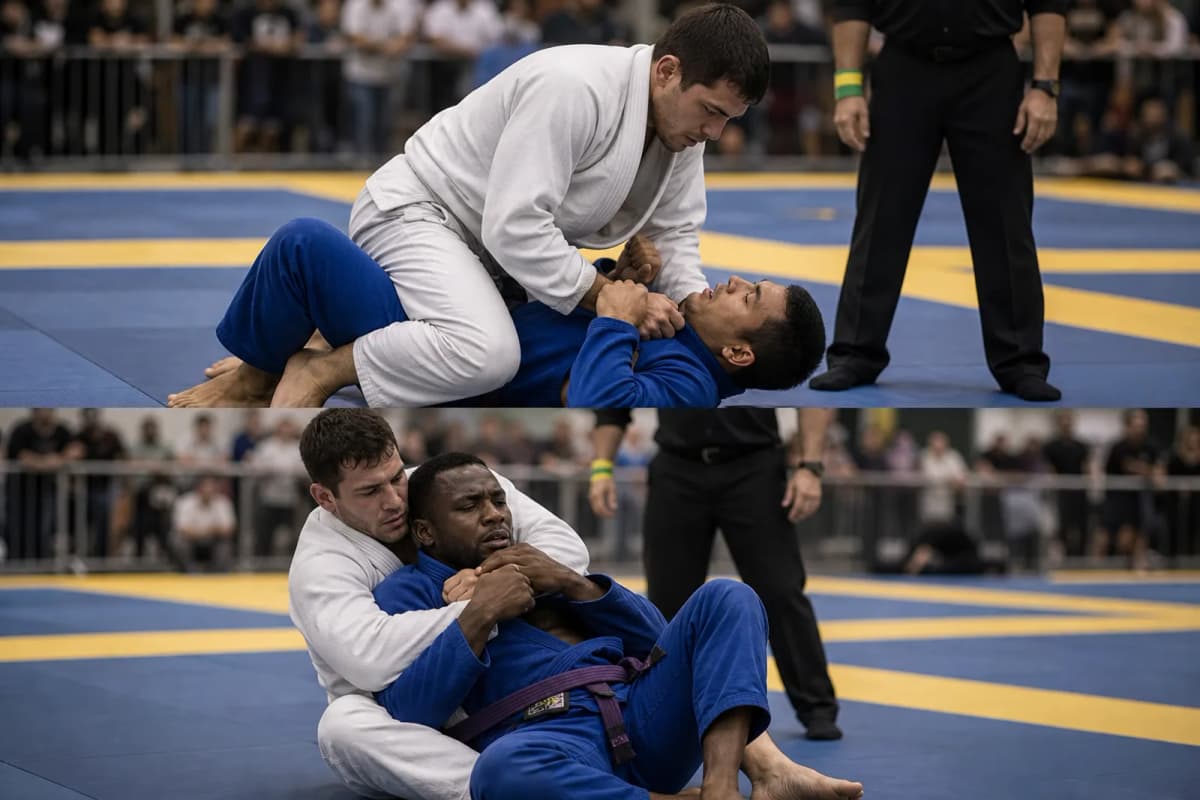
An IBJJF match lasts 5 minutes at adult white belt and adds time with each belt, up to 10 minutes at black belt. Masters and kids matches are shorter. Points decide the match if nobody taps, then advantages, then penalties. Source: IBJJF Rule Book v6.1 (June 2024). Last verified 2026-10-21.
IBJJF match times by age and belt
Age is the competition year minus your birth year. Under 18 the time depends on age only.
- Kids, teen and juvenile divisions use one match time for every belt in the division.
- Juveniles compete at white, blue and purple belt.
- Rest between matches is at least one match time for every round up to the semifinal, and two match times before a final.
| Division | Age | Match time |
|---|---|---|
| Mighty Mite 1–3 | 4–6 | 2 min |
| Pee Wee 1–3 | 7–9 | 3 min |
| Junior 1–3 | 10–12 | 4 min |
| Teen 1–3 | 13–15 | 4 min |
| Juvenile 1–2 | 16–17 | 5 min |
| Adult | 18+ | White 5 · Blue 6 · Purple 7 · Brown 8 · Black 10 min |
| Master 1 | 30+ | White and blue 5 · Purple, brown and black 6 min |
| Master 2 | 36+ | 5 min, every belt |
| Master 3–7 | 41+ to 61+ | 5 min, every belt |
IBJJF points table
Points are given when you hold a scoring position for 3 seconds.
- Points stack in a chain: a guard pass straight into mount is 3 + 4 = 7.
- Going from back mount to mount (or the reverse) scores both, because they count as different positions.
- Giving up a position on purpose to score it again earns nothing.
- If you reach a scoring position while caught in a submission, you only score once you escape and hold it for 3 seconds.
- Taking a defensive exit out of the area to escape a submission gives your opponent 2 points.
| Position | Points | What the referee looks for |
|---|---|---|
| Takedown | 2 | Start on two feet, put your opponent on their back, side or seat, and hold top position |
| Sweep | 2 | From guard or half guard, reverse so you end on top |
| Knee on belly | 2 | Knee or shin on belly, chest or ribs, other knee off the mat, opponent on back or side |
| Guard pass | 3 | Get past the legs into side control or north-south |
| Mount | 4 | Sit on the torso facing the head, up to one arm trapped, clear of half guard |
| Back mount | 4 | Mounted on the back |
| Back control | 4 | Both heels inside the thighs, legs not crossed, up to one arm trapped below the shoulder |
Advantages
An advantage is a near-score. It only matters if points are tied.
- You get an advantage when you reach a scoring position but cannot hold it for the full 3 seconds.
- A submission attempt that puts your opponent in real danger also earns one.
- The referee gives it only once there is no chance left of completing the score, and can give it after time runs out, before the result.
- When both athletes pull guard at the same time, the first to reach top position gets an advantage.
- No advantage for half guard that did not come from a passing attempt, for sweeps that start and end in 50/50, or for a single leg that drags the opponent out of the area.
Penalties
Serious fouls and stalling share one escalating count. Severe fouls disqualify at once.
- Stalling: the referee counts 20 seconds without an attempt to progress, then penalizes. Defending from under mount, back, side control or north-south is not stalling.
- If both athletes pull guard at once, they have 20 seconds to get on top, attack or score. Otherwise both are penalized and restarted standing.
- Serious fouls include pulling guard without a grip, fleeing the area, fingers inside sleeves or pant legs, a foot on the face, and in no-gi grabbing clothing.
- Fleeing the area to avoid a worse position costs a penalty and gives your opponent 2 points.
- Jumping guard is a serious foul for all under-15 divisions and all white belts.
- Severe fouls disqualify at once: a hold illegal for your division, fleeing a submission, slippery substances, slams and the other banned moves on the illegal moves table.
| Penalty | Standard | Under-15 divisions |
|---|---|---|
| 1st | Penalty marked only | Penalty marked only |
| 2nd | Opponent gets an advantage | Opponent gets an advantage |
| 3rd | Opponent gets 2 points | Opponent gets 2 points |
| 4th | Disqualification | Opponent gets 2 points |
| 5th | — | Opponent gets 2 points |
| 6th | — | Disqualification |
How a tied match is decided
IBJJF checks four things in order.
- 1. Points.
- 2. Advantages.
- 3. Fewer penalties.
- 4. Referee decision, based on who attacked more and came closer to scoring or submitting.
- If both athletes are hurt by accident in a tied final and neither can go on, the result is a random pick.
Key Takeaways
- Adult match times: 5 minutes at white belt, 6 blue, 7 purple, 8 brown, 10 black.
- Master 1 brown and black belts fight 6 minutes. Master 2 and older fight 5 minutes at every belt.
- Points: takedown, sweep and knee on belly 2; guard pass 3; mount, back mount and back control 4.
- Ties go to advantages, then fewer penalties, then the referee.
- Four penalties disqualify you (six under 15).
Further Study
IBJJF Books and Videos (Rule Book v6.1, June 2024)
The official Rule Book and General Competition Guidelines this page follows.
Understanding IBJJF points
How to use the points hierarchy in your game.
IBJJF masters age divisions: 2026 and 2027 chart
Which age division, and so which match time, your birth year gives you.
All IBJJF rules on Open BJJ
Divisions, scoring, uniform and illegal moves in one hub.