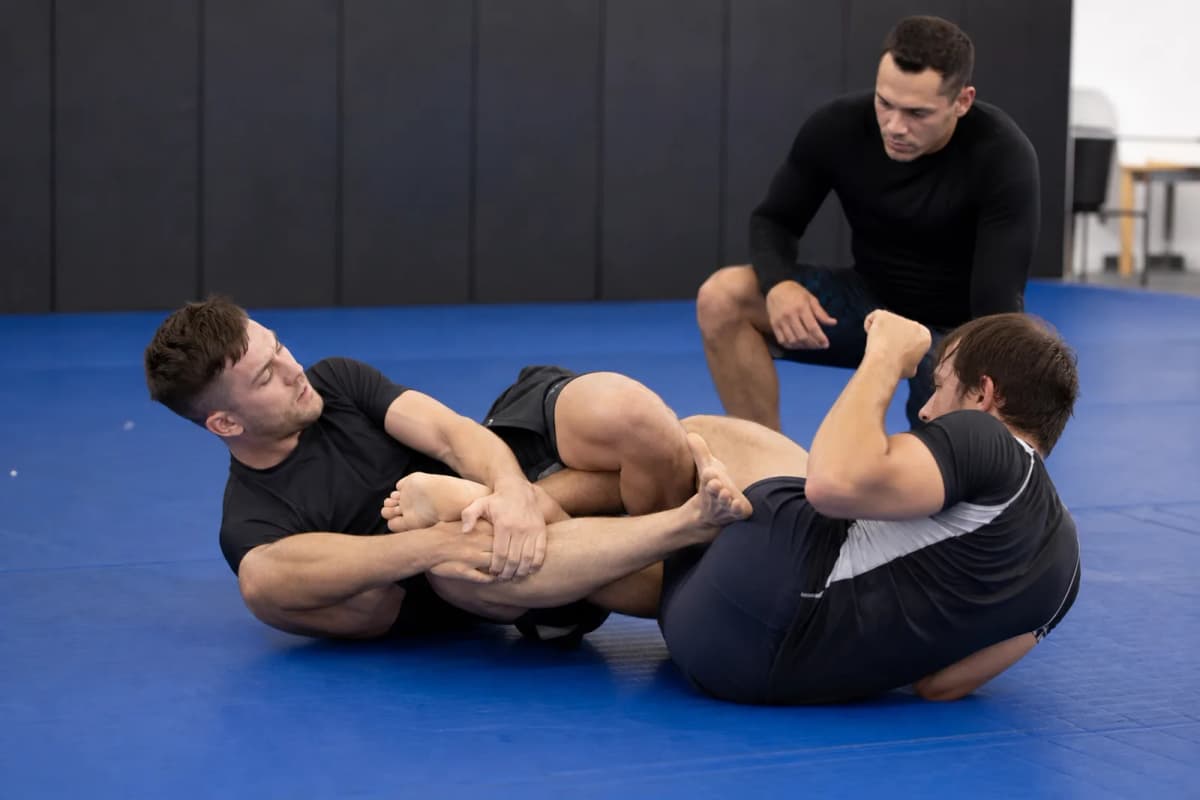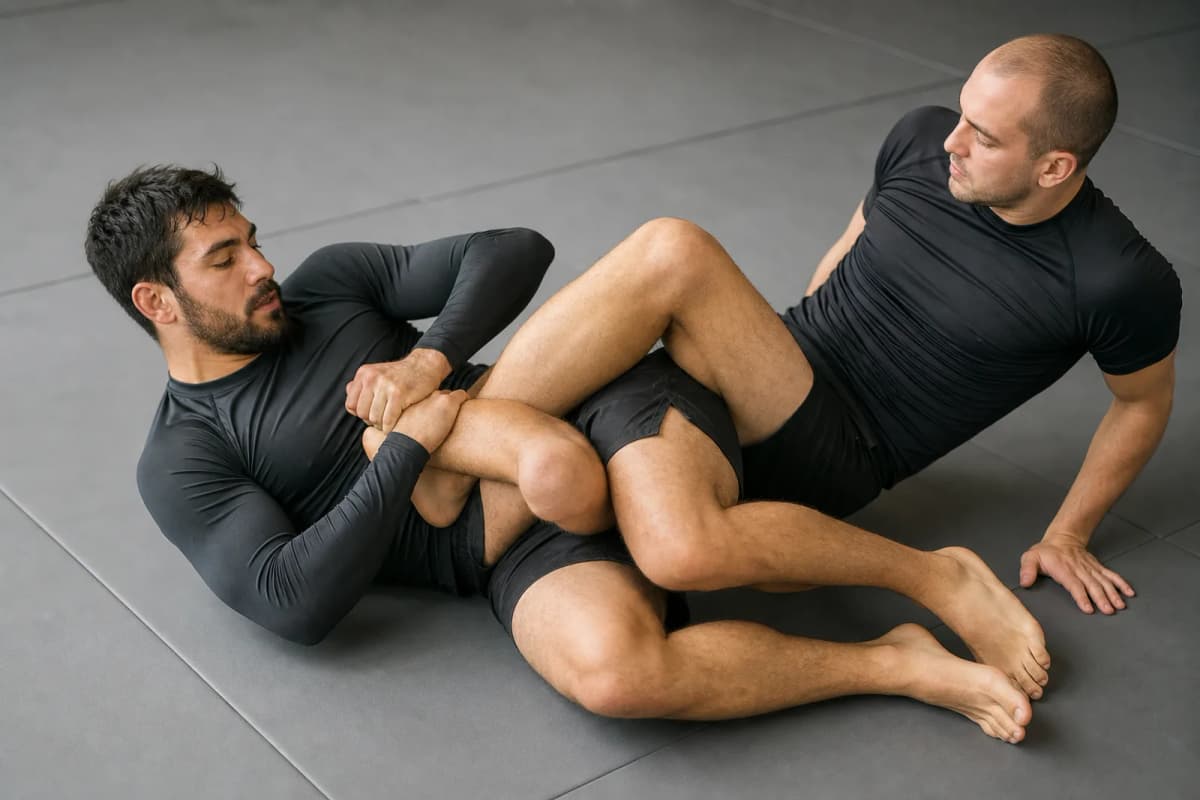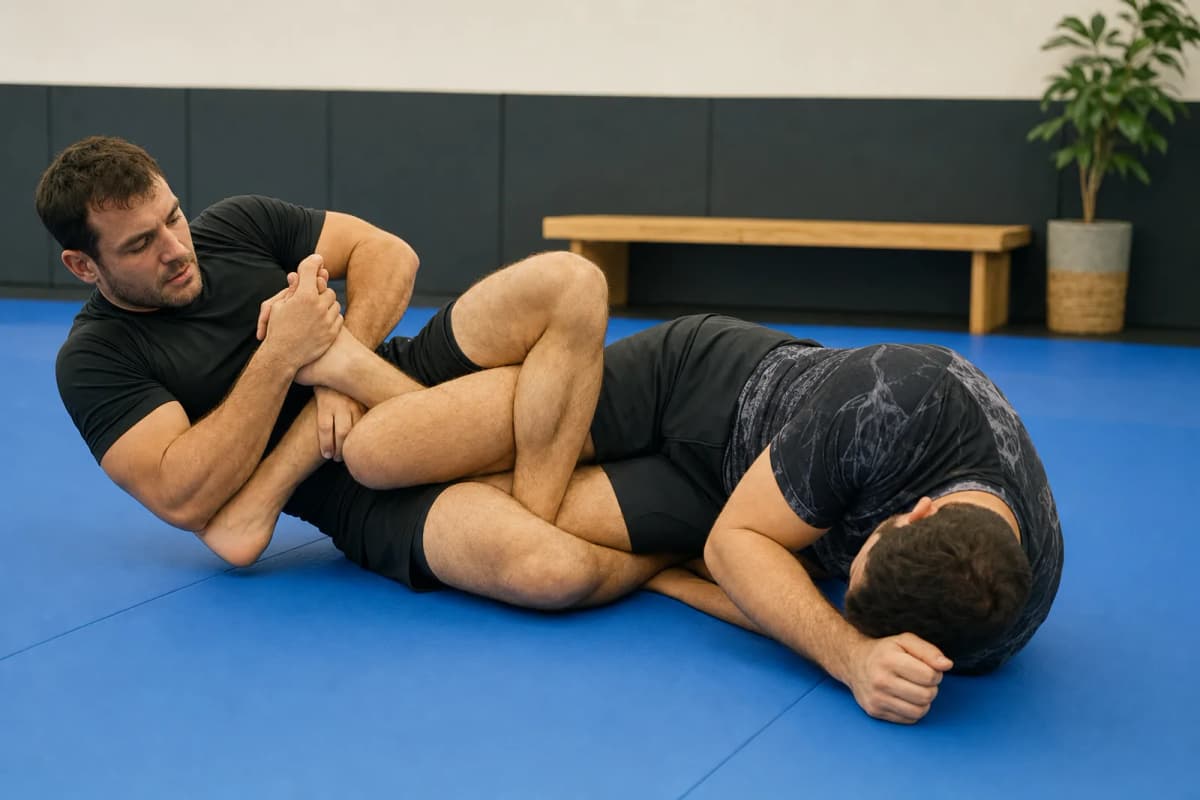
Reaping is a leg position, not a submission: your leg wraps behind the opponent’s thigh and crosses their body with the foot past their midline while their foot is trapped. In IBJJF it is legal only for adult brown and black belts in no-gi. A false reap looks similar but does not wrap the attacked leg, so it is not reaping under the Rule Book.
The IBJJF definition of reaping
Item 19 of the IBJJF Technical Fouls and Illegal Moves table is knee reaping. Page 32 of the Rule Book v6.1 defines it.
The Rule Book says knee reaping happens when an athlete “places his thigh behind the leg of his opponent and passes his calf on top of the opponent’s body above the knee, placing his foot beyond the vertical midline of the opponent’s body and applying pressure on his opponents knee from the outside, through inside, while keeping the foot of the leg at risk trapped between his hip and armpit.”
Three details decide most arguments. First, you do not have to hold the foot: “It is not necessary for one of the athletes to hold the foot of his opponent in order for the foot to be considered trapped.” Second, a standing opponent’s foot counts as trapped when they bear weight on it with the same leg as the knee in danger. Third, the foot has to cross the midline. The Rule Book’s photos of normal situations that are not fouls include a free foot and a leg crossing under the knee.
How IBJJF penalises a reap
- Serious foul: the foot crosses the vertical midline. The referee stops the match, returns the position if permitted, and gives a penalty before restarting.
- Severe foul: the foot crosses the far edge of the opponent’s body (the Rule Book’s “body’s limit”). A severe foul is a disqualification from the match.
- Severe foul: either athlete has a submission hold while the foot crosses.
- 50/50 guard: if you turn inside while the opponent is standing on the foot that is in your guard, that foot counts as trapped, so the turn can be a reap. The Rule Book illustrates it as a severe foul.
- Purple belt and below: if two seated athletes have crossed legs in a legal position and one stands up, the standing foot becomes trapped. The referee stops the match and restarts with one athlete seated and one standing. After a sweep, the referee waits 3 seconds, gives the 2 points, then restarts.
- Brown and black belt: in that standing-up case the referee does not stop the fight and gives no penalty.
Reap vs false reap
Both positions put one of your legs across the opponent’s body. What differs is which leg it wraps.
In a true reap, your thigh is behind the leg at risk and your calf crosses their body above that knee, so the pressure on that knee comes from the outside in. That is the shape the Rule Book describes, whether or not you are attacking that leg.
In a false reap, your leg crosses the opponent’s body, but it is not wrapped behind the thigh of the leg you attack. You usually attack the far leg. That is why it is called false: it looks like a reap from a distance, but it does not meet the definition. Players use it to reach an inside heel hook on the far leg, or to come up on the back.
The IBJJF table does not name the false reap, and the Rule Book notes its images are examples, not every prohibited variation. If your legs drift and the position turns into a real reap, it is a foul. The referee makes that call on the mat.
The finish carries its own ruling
A legal false reap does not make the heel hook legal. In IBJJF, heel hooks are legal only for adult brown and black belt in no-gi; illegal for masters, the gi, and every age and belt below adult brown belt.
Where reaps show up
Reaps come up from outside ashi, the saddle and 50/50 guard. In inside ashi, the usual straight foot lock entanglement, your outside foot stays on their near hip, short of the midline.
Where reaping is legal
Reaping and heel hooks are separate rules, and the rulebooks do not always open them together.
| Ruleset and division | Knee reaping | Heel hook |
|---|---|---|
| IBJJF ages 4–15 | illegal | illegal |
| IBJJF ages 16–17 and adult or masters white | illegal | illegal |
| IBJJF blue and purple | illegal | illegal |
| IBJJF brown and black, gi and masters | illegal | illegal |
| IBJJF adult brown and black, no-gi | legal | legal |
| ADCC World Championship and Trials | not specified by the rulebook | legal |
| ADCC Opens kids 12 and under | illegal | illegal |
| ADCC Opens teens 13–17 | legal with conditions | illegal |
| ADCC Opens adults, white to purple | legal | legal |
| ADCC Opens adults, brown and black | legal | legal |
| Grappling Industries under 18 | illegal | illegal |
| Grappling Industries adult white | illegal | illegal |
| Grappling Industries blue; purple in the gi | legal | illegal |
| Grappling Industries no-gi, purple to black | legal | legal |
| NAGA no-gi adult novice and beginner | not specified by the rulebook | illegal |
| NAGA no-gi adult intermediate and expert | not specified by the rulebook | legal |
| NAGA gi, every belt | illegal | illegal |
What the other rulebooks say
ADCC: the rules’ general legal and illegal lists, which cover the World Championship and Trials, do not mention reaping, so at those events it is not specified by the rulebook. The same PDF’s Opens lists ban it for kids 12 and under and allow it for teens. The ADCC Opens grid splits it into two rows: “Reaping - Unlocked: Legs not crossed on reaped leg. No locked subs on reaped leg. Reap to sweep OK” and “Reaping - Locked: Reaper’s legs crossed or submission on reaped leg, NO belly-down CROSS ashi”. Our matrix reads the grid as reaping illegal for kids 12 and under and legal with conditions for teens 13–17: unlocked reaping only, with no crossed legs and no submission on the reaped leg.
Grappling Industries: the chart’s Knee Reap row makes reaping illegal for under 18 and adult white belt, and legal from blue belt, gi and no-gi. The chart note for under 18 and adult white belt or beginner divisions says a reap without a submission first gets a penalty and the reap is removed; a second reap, or a reap with a submission, is a disqualification. Blue belts can reap there while heel hooks stay illegal.
NAGA: in the gi, reaping is illegal at every belt, and the teen gi rules say “No reaping of the knee will be permitted”. Neither technique chart has a reaping row, so for adults in no-gi it is not specified by the rulebook. The teen no-gi section says only that “In the case of a straight ankle lock, there can be no reaping of the knee”. Ask the referee at the rules meeting.
Training it safely
- Below adult brown and black no-gi in IBJJF, keep your foot on the near side of their midline, or use inside ashi.
- In training, agree with your partner which rules you are rolling under, and tap early to any heel hook from a reap or false reap.
- Check your event’s ruleset, belt and age group with the legality matrix before you enter.
Key Takeaways
- IBJJF defines reaping as thigh behind the leg, calf across the body above the knee, foot past the midline, and the attacked foot trapped between hip and armpit.
- In IBJJF, knee reaping is legal only in adult brown and black no-gi.
- A false reap crosses the body without wrapping the attacked leg, so it is not reaping, but the heel hook from it keeps its own ruling.
- At the ADCC Opens reaping is illegal for kids 12 and under, legal with conditions for teens 13–17 (unlocked reaping only), and legal for adults and masters. At Grappling Industries it is legal from blue belt.
Further Study
IBJJF Books and Videos (Rule Book v6.1)
Official IBJJF Rule Book: the Illegal Moves table (item 19, knee reaping) and the reaping definition and fouls on pages 32–33.
IBJJF heel hook and knee reaping update
Official IBJJF notice opening heel hooks and knee reaping to adult brown and black no-gi.
ADCC Rules and Regulations
Official ADCC rules PDF (version of 2026-10-19), linked from adcc-official.com.
ADCC Opens legal techniques grid
The unlocked and locked reaping rows by Opens division.
Grappling Industries rulebook
The Knee Reap chart row and the penalty note for under 18 and white belt divisions.
NAGA rules
NAGA gi and no-gi rules, including the gi reaping example.
Submission legality matrix: IBJJF, ADCC, NAGA, Grappling Industries
Knee reaping and heel hooks in every IBJJF, ADCC, NAGA and Grappling Industries column.
False Reap
The false reap position and where it leads.
Heel Hook
Heel hook mechanics and legality by ruleset.
Are heel hooks legal at white belt?
Heel hook rules by belt across IBJJF and ADCC.