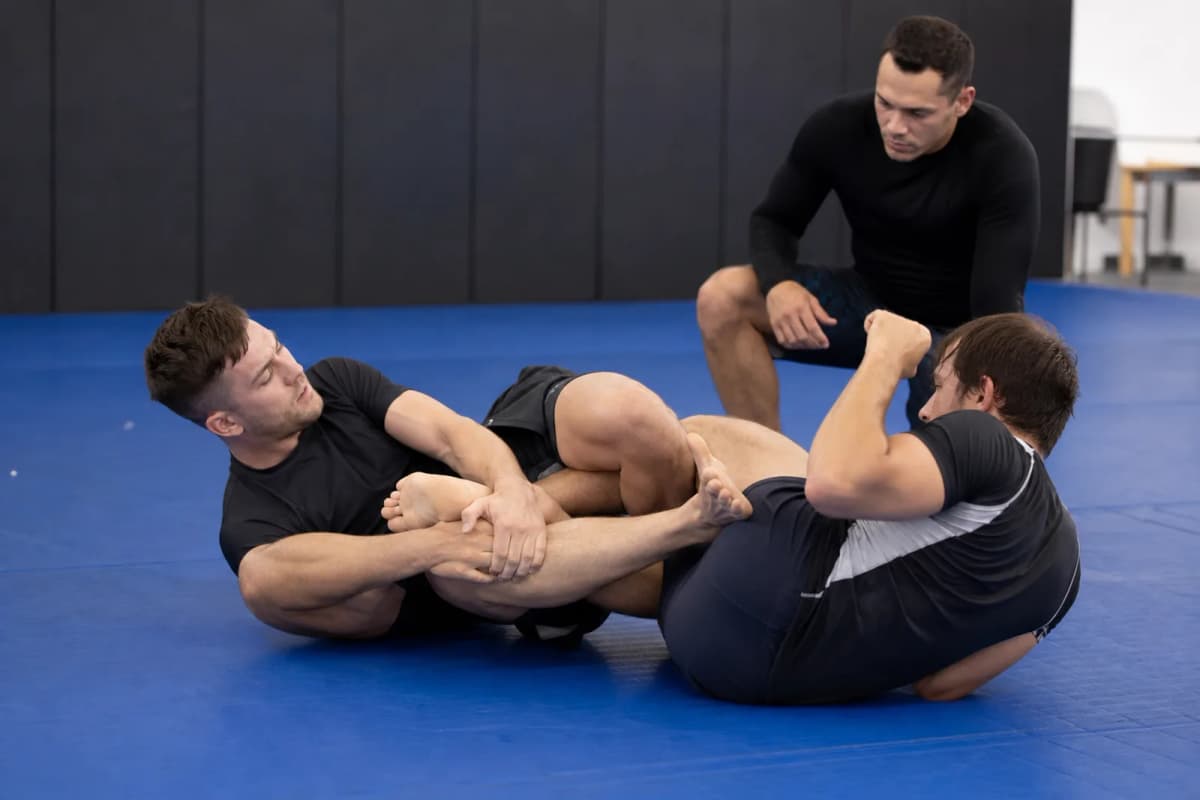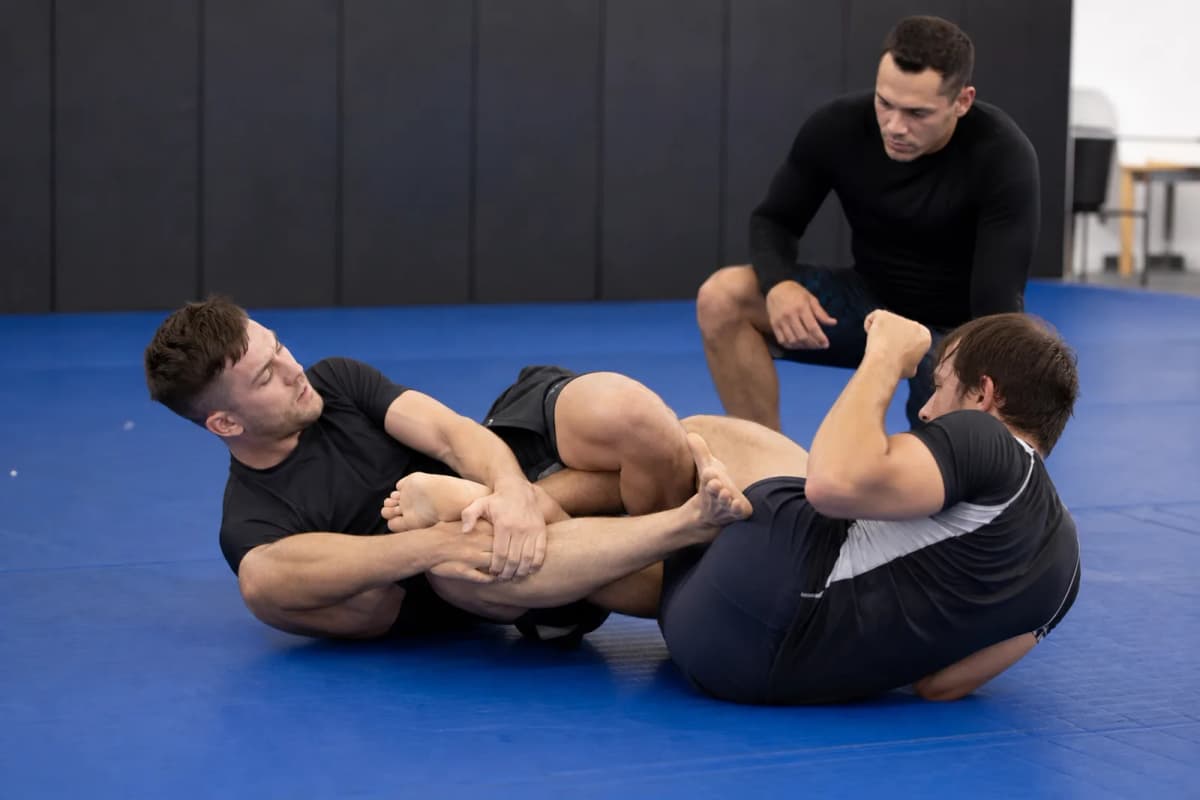
Most white belts enter an IBJJF, NAGA, Grappling Industries or ADCC Open event first. The four rulebooks disagree on leg locks, match length, scoring and weigh-ins. This guide puts the white-belt and beginner divisions side by side, from each organiser’s official rules. Last verified 2026-10-25.
What a white belt can submit with, by organiser
Each organiser’s own white-belt or beginner division. The basics (armbar, triangle, rear naked choke, guillotine) and the straight ankle lock are legal in all of them; the differences are below.
Two things stand out. First, NAGA’s no-gi novice and beginner rules are wider than its gi white-belt rules: knee bars and toe holds are legal in no-gi and illegal in the gi. Second, the ADCC Opens grid gives white belts the same technique list as blue and purple belts (one Beg/Int column), and that list allows heel hooks.
Every cell links back to a rule reference in the submission legality matrix, which also has the kids, teen and black-belt columns. For the full IBJJF white-belt list with explanations, see what submissions are illegal at white belt (IBJJF). To check another IBJJF age or belt, use the IBJJF rules checker.
| Technique | IBJJF adult white | NAGA no-gi novice/beginner | NAGA gi white | Grappling Industries adult white | ADCC Opens beginner/intermediate |
|---|---|---|---|---|---|
| Straight ankle lock | legal | legal | legal | legal | legal |
| Wrist lock | illegal | legal | illegal | legal | legal |
| Body compression with the legs | illegal | legal | illegal | legal | legal |
| Bicep slicer | illegal | legal | illegal | illegal | legal |
| Calf slicer | illegal | legal | illegal | illegal | legal |
| Knee bar | illegal | legal | illegal | illegal | legal |
| Toe hold | illegal | legal | illegal | illegal | legal |
| Heel hook | illegal | illegal | illegal | illegal | legal |
| Knee reaping | illegal | not specified by the rulebook | illegal | illegal | legal |
| Neck crank | illegal | legal | illegal | illegal | legal with conditions |
| Twister | illegal | legal | illegal | illegal | legal |
| Scissor takedown (kani basami) | illegal | legal with conditions | illegal | illegal | illegal |
| Slam | illegal | illegal | illegal | illegal | illegal |
How long a white belt match lasts
Adult divisions, regulation time, from each organiser’s current rules.
Train rounds at the length you will compete. A 4-minute NAGA match leaves little time to recover from an early takedown, while at the ADCC Opens nothing scores in the first 3 minutes, so a takedown in the first half scores nothing. IBJJF times by belt and age are in IBJJF match times and points.
| Organiser | Adult white belt / beginner match | Overtime |
|---|---|---|
| IBJJF | 5 minutes (Master 1 white belt: also 5) | None: advantages, then penalties, then the referee decides |
| NAGA | 4 minutes (adults 18–29, novice and beginner, gi and no-gi) | 2 minutes |
| Grappling Industries | 5 minutes (every adult, master and senior match) | None: penalties, then a referee decision (no advantages) |
| ADCC Opens | 6 minutes: first 3 without points, second 3 with points | 3 minutes |
Points basics
All four score positions, but not with the same values.
In IBJJF a position must be held for 3 seconds to score, and ties go to advantages, then penalties. The details, including how advantages are given, are in understanding IBJJF points.
At the ADCC Opens, pulling guard costs you. The rules give a minus point to an athlete who jumps to guard or sits down from standing and stays down for 3 seconds or more, during the points period and overtime, and in finals during the no-points half too.
| Position | IBJJF | NAGA gi | NAGA no-gi | Grappling Industries | ADCC Opens |
|---|---|---|---|---|---|
| Takedown | 2 | 2 | 2 (some takedowns 1) | 2 | 2 (clean takedown 4) |
| Sweep | 2 | 2 | 2 | 2 | 2 (clean sweep 4) |
| Knee on belly | 2 | 2 | 2 | 2 | 2 |
| Guard pass | 3 | 3 | No pass category; side control 2 | 3 | 3 |
| Mount | 4 | 4 | 2 | 4 | 2 |
| Back control | 4 | 4 | 2 | 4 | 3 (back mount) |
| Submission attempt | Advantage | Advantage | 1 or 2 | 2, if stopped out of bounds | Not in the positive points list |
Rules that only apply to white belts and beginners
Beyond the submission list, these are the beginner-specific rules we found in the official rulebooks.
- IBJJF, jumping guard: in all white-belt age groups, jumping closed guard on a standing opponent is a foul, including flying triangles and flying armbars. The referee stands both athletes up. If the opponent was defending a takedown or sweep, they get 2 points (Rule Book v6.1, 6.2.2 W).
- IBJJF, single leg with the head outside: for white belts the referee stops the match and restarts both athletes standing, without a penalty (Rule Book v6.1, 1.3.10).
- IBJJF, who can enter at white belt: a black belt in judo, freestyle or Greco-Roman wrestlers (college level or national level events) and anyone who has fought MMA cannot enter as a white belt (Rule Book v6.1, General Competition Guidelines 5.5).
- IBJJF, heel hooks and reaping: both are illegal at adult white belt. See are heel hooks legal at white belt? for every organiser’s answer.
- Grappling Industries, knee reaping: in under-18 and adult white-belt divisions, a first reap without a submission is a penalty. A second one, or a reap with a submission, is a disqualification. Pulling guard without a grip on the opponent is a penalty and a restart at any level.
- NAGA, slams: the no-gi rules say “Slamming an opponent on a takedown, to escape any position or as an escape to any submission attempt is ILLEGAL.” The gi rules say “No slamming from the Guard or to escape submission.”
- ADCC Opens, slams: the general rules allow slams only at adult Trials and the World Championship, so they are illegal at the Opens.
What to expect on the day
Weigh-in and check-in differ more than the submission rules do.
IBJJF
You weigh in once, right before your first match, wearing the gi in gi divisions and the no-gi uniform in no-gi. If you miss weight you are disqualified at once. Before the weigh-in an inspector checks the gi (sleeve and pant length, collar, belt); you get 3 inspections to pass. No shoes on the scale, and braces can come off for the weigh-in but must be on for the gi check. After weighing in you cannot change gis for your first match. Weight limits are in IBJJF weight classes.
Grappling Industries
Check in and weigh in any time up to at least 60 minutes before your division starts. There is no weight allowance. Gi competitors may weigh in without the gi. Divisions of 3 to 5 people are round robin, so a white belt often gets several matches, not just one.
NAGA
The rules let gi competitors weigh in without the gi. NAGA runs separate gi and no-gi divisions, and the no-gi rules differ from the gi rules on leg locks and scoring, so read the section for the format you entered.
ADCC Opens
No-gi only. Bring a valid ID or passport: adults must show one at weigh-in. White belts register as beginners (or intermediate with 2+ years in another grappling art), and follow the grid’s beginner/intermediate column, not the World Championship rules.
A simple plan for your first tournament
Pick the event, then read its rulebook and the legal-techniques chart for your exact division: age, belt or skill level, gi or no-gi. The table above shows how much the answer changes between organisers.
Drill only finishes that are legal everywhere you plan to compete, so a scramble never ends in a disqualification. For the practical side (what to pack, when to arrive, warming up), see the competition day checklist.
Key Takeaways
- White-belt legality is set per organiser and per division. IBJJF, NAGA gi and Grappling Industries are strict on leg locks; NAGA no-gi beginner and ADCC Opens are wider.
- Heel hooks are illegal at white belt in IBJJF, NAGA and Grappling Industries, and legal in the ADCC Opens beginner/intermediate division.
- Slams are illegal for white belts everywhere.
- IBJJF white belts cannot jump closed guard, and IBJJF weigh-ins happen in the gi, once, right before the first match.
- Match length runs from 4 minutes (NAGA) to 6 minutes (ADCC Opens).
Further Study
IBJJF Rule Book v6.1 (Books and Videos)
Official IBJJF Rule Book: illegal moves table, match times, points, jumping-guard rule and uniform checks.
IBJJF weigh-ins
Official page: weigh in with the gi before your first match, one attempt, immediate disqualification if you miss weight.
NAGA Rules (PDF)
Official NAGA no-gi and gi rules: match times (pp. 21, 81), points, slams and legal techniques.
Grappling Industries rules
Official rules page: 5-minute matches, points, round-robin format and weigh-in times.
Grappling Industries Rulebook (2026-02-09, PDF)
Full rulebook with the legal techniques chart and the white-belt knee-reap rule.
ADCC rules page
ADCC Opens match lengths and skill levels by belt, with links to every official rules PDF.
ADCC Rules and Regulations (2026-10-19, PDF)
Opens time limits, positive and negative points, and slam rules.
ADCC Opens Legal Techniques by Division
Official Opens grid (updated 7/20/2026) for the beginner/intermediate column.
ADCC weight classes, divisions and categories (PDF)
ADCC Opens divisions and the ID requirement at weigh-in.
Submission legality matrix
Every IBJJF, ADCC, NAGA and Grappling Industries division side by side, with the rule behind each cell.
IBJJF rules checker
What is illegal for your IBJJF age and belt.
Understanding IBJJF points
Points, advantages and penalties in plain language.
IBJJF weight classes
Gi and no-gi limits in kg and lb, with a calculator.