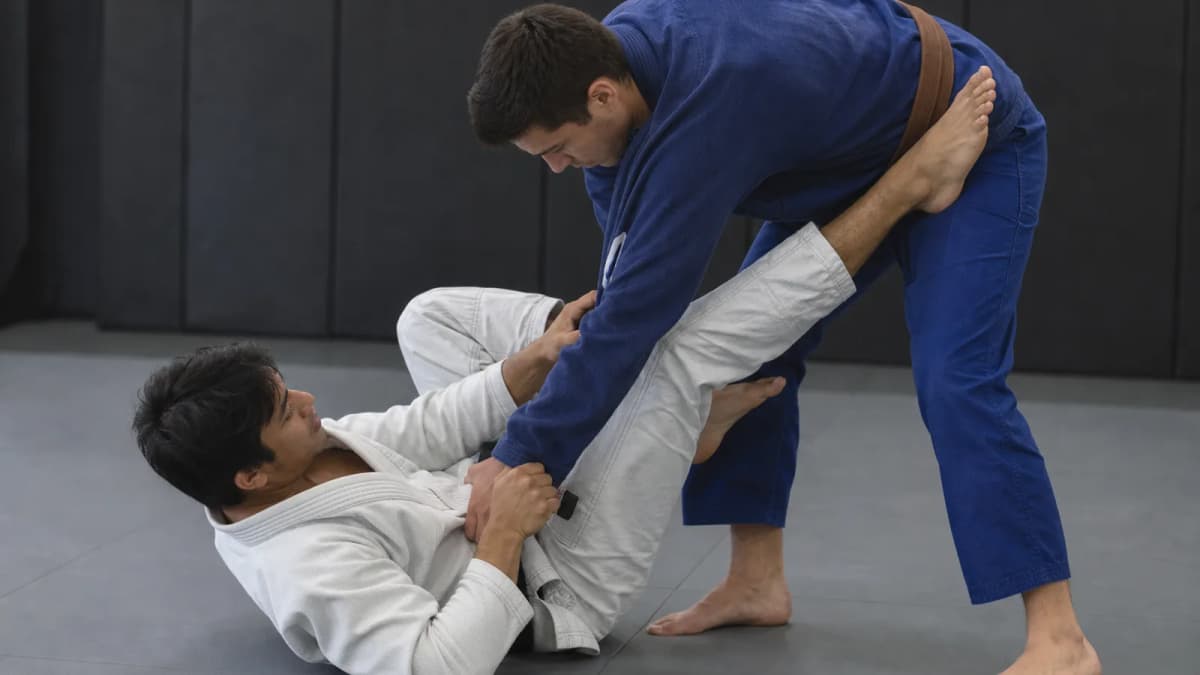
X-Guard
Open-guard entanglement that elevates the opponent on crossed hooks — a hub for sweeps, single-leg X, and leg-lock entries.
Overview
X-guard puts one of the opponent’s legs between your crossed hooks while you elevate their base. From there you can off-balance for sweeps, transition to single-leg X, or enter straight and rotational leg attacks depending on the ruleset.
Position Flow
How to Enter
- Elevate from butterfly when you insert the far hook under their thigh
- Enter from open guard after a failed pass leaves one leg trapped
- Transition from single-leg X by re-crossing hooks under a standing opponent
How to Exit
- Technical stand-up sweep to come up in the single-leg or on top
- Single-leg X when you want a tighter ashi-style entanglement
- Knee bar or ankle lock entries when the elevated leg is isolated
- Disengage back to butterfly or open guard if base collapses on you
Key Controls
- Crossed hooks: one behind the far thigh, one under the near hamstring/calf line
- Upper-body connection via sleeve, collar, or ankle/knee grips to stop them stepping out
- Hips under their center of gravity so elevation is structural, not arm strength
Vulnerabilities
- Opponent knees down and kills elevation before hooks settle
- Passing pressure that clears the near hook and stacks your shoulders
- Heel exposure on your own free leg during messy entries
Ideal When
You want an elevating open guard that creates sweep angles and clean paths into modern leg entanglements.
OffenseOffense
Goals
- Elevate and break their base before they plant both feet
- Force a reaction that opens a sweep or a secondary entanglement
Key Techniques
- Technical stand-up / X-guard sweep to the elevated side
- Single-leg X transition for ankle lock and heel-hook entries
- Knee bar when the far leg straightens across your hips
Pro Tips
- Win the elevation race early; late X-guard against a planted passer is harder
- Keep the far hook deep enough that they cannot simply step over
Common Mistakes
- Crossing hooks without hips underneath — you get stacked instead of elevated
- Hunting submissions before the base is broken
DefenseDefense
Goals
- Kill elevation and clear the near hook
- Keep posture and connections that prevent the technical stand-up
Key Techniques
- Knee-down base with hand posts to stop the lift
- Backstep or long-step clears once the near hook loosens
- Pressure pass into half guard when they lose the far hook
Pro Tips
- Do not stand tall over unfinished hooks
- Address the near hook first; the far hook alone rarely sweeps
Common Mistakes
- Pulling away and giving them a clean single-leg X
- Reaching for feet while your base is already elevated
Variations
Standard X-guard under a standing opponentShin-to-shin entries that build into X-guardX-guard to single-leg X chains for leg-lock games
Key Concepts
- Elevation is the position — submissions and sweeps are the payoff
- Hook depth and hip placement matter more than upper-body strength
- X-guard is a hub: treat exits as a menu, not a single finish
Recommended Drills
- Butterfly-to-X elevation reps with a cooperative partner
- Technical stand-up sweep chains to top half or single-leg
- X-guard to single-leg X transitions without finishing submissions
Related Techniques
Summary
X-guard wins by putting their weight on your hooks. Elevate early, keep hook depth, then choose the exit — sweep, single-leg X, or a controlled leg attack — based on how they defend.