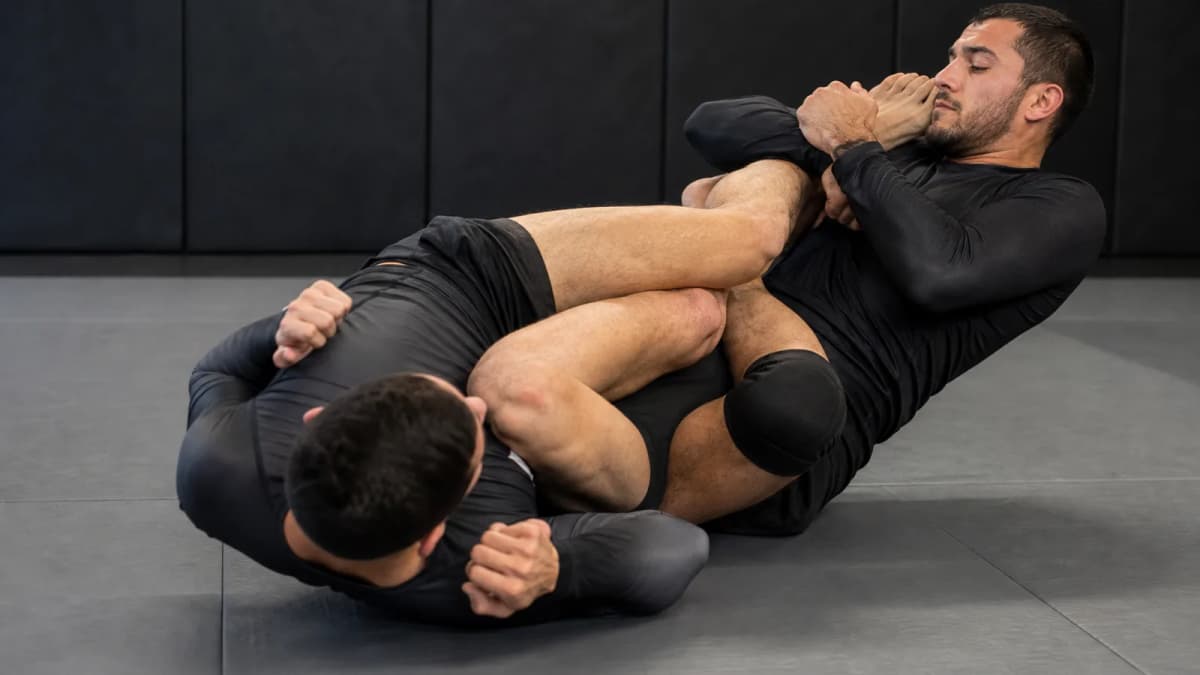
What is the Knee Bar?
The knee bar hyperextends the knee by controlling the lower leg like an armbar controls the arm. Hips tight to the knee, thigh isolation, and a clean breaking arc matter more than yanking the foot.
Setup
- Isolate one leg and pinch it between your knees with their knee near your hips.
- Control the foot or ankle so they cannot circle out of the breaking line.
- Align your hips perpendicular to their thigh before extending.
Execution
- Pinch knees, arch hips into the knee, and pull the lower leg toward your chest.
- Keep their hips from following by controlling the free leg or posting into their torso.
- Extend gradually along a straight line — twisting turns it into a different (often illegal) attack.
Finishing
- Close any gap between your hips and their knee before adding pressure.
- If they roll, follow the hip line or switch to a secondary entanglement.
- Release on tap immediately; knee hyperextension injuries escalate quickly.
⚠️
Safety Warning
Knee bars load the knee joint directly. Apply pressure slowly in training and never crank through a stuck partner. Know your ruleset before hunting them in competition.
Primary Targets
- Knee
Key Concepts
- Hips to the knee, not arms to the foot.
- Straight-line extension is the finish; uncontrolled twisting is a different attack.
- Secondary-leg control stops the most common roll escapes.
Primary Entries
- X-guard and single-leg X when the far leg is elevated.
- Top-side transitions after failed passes that leave a trapped leg.
- Ashi entries when the opponent posts and straightens the trapped leg.
Defenses & Counters
- Expect them to grab your far leg or belt and roll toward the free hip — follow or abandon early.
- Watch for heel digs that create space at your hip line; re-pinch before extending.
- If they hide the foot and turn in, switch to ankle lock or disentangle rather than forcing a bad arc.
Follow-Ups
- Straight ankle lock when the foot is controlled but the knee line softens.
- Heel hook if rules allow and the heel becomes available during the scramble.
- Mount or side control when they give up the leg to escape.
Training Drills
- Hip-alignment reps from a static knee-bar hold to a light tap.
- Entry chains from X-guard elevation into knee-bar control without finishing.
- Escape recognition rounds where the bottom player only rolls and the top player must follow cleanly.
Related Techniques
Deepen your study with complementary positions and attacks.
Summary
A good knee bar looks like an armbar for the leg: isolate, close the hip gap, and extend on a straight line. Control first, then pressure — that is what separates clean finishes from stalled cranks.